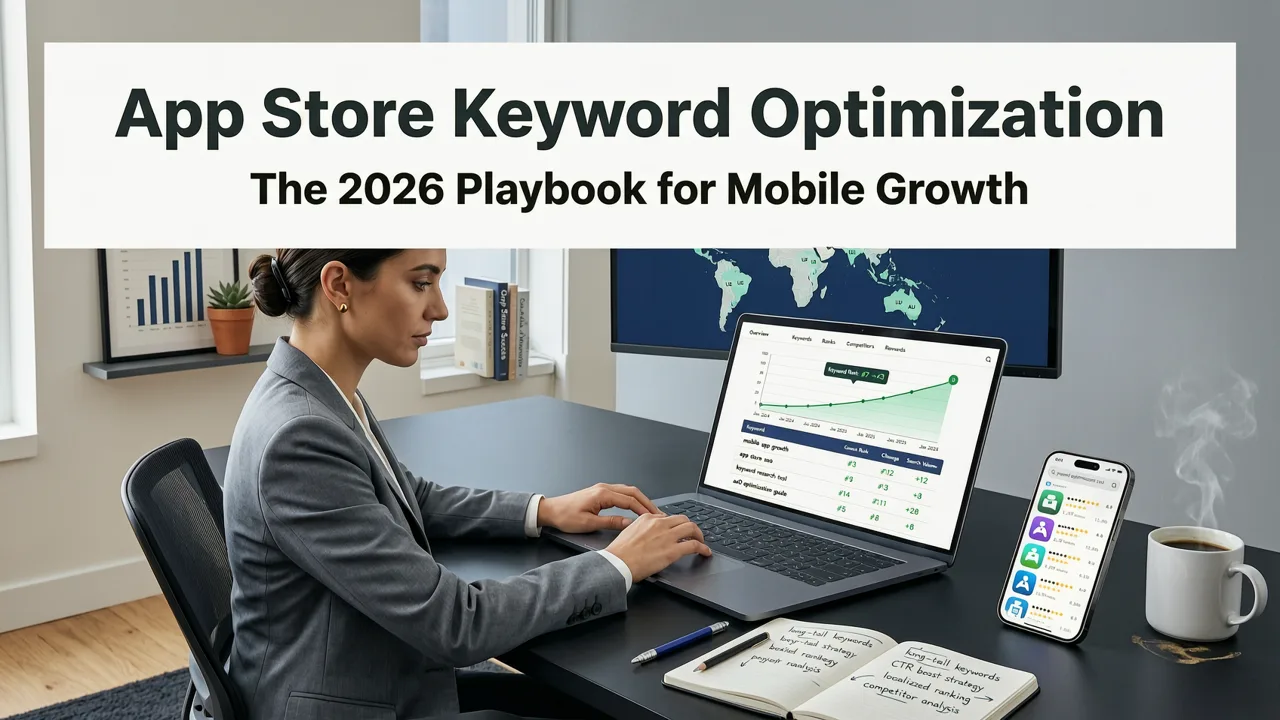
App Store Keyword Optimization: The 2026 Playbook
App store keyword optimization is the strategic process of selecting, placing, and refining high-intent, low-competition keywords in your app’s metadata to improve organic visibility and conversion across the Apple App Store and Google Play. In 2026, it remains the single most controllable lever for sustainable, scalable app growth — especially as both platforms continue tightening algorithmic reliance on semantic relevance, user behavior signals, and contextual alignment over exact-match stuffing.
This guide cuts through outdated tactics and delivers a field-tested, platform-aware framework for app store keyword optimization that reflects how Apple Search Ads, App Store Connect’s new keyword scoring model (introduced in Q2 2026), and Google Play’s updated ranking signals actually work today.
Why App Store Keyword Optimization Matters More Than Ever in 2026
The mobile app ecosystem has crossed a structural inflection point. As of late 2026, there are over 4.2 million apps live on Google Play and more than 1.9 million on the App Store — yet average organic install velocity for new apps has declined by 37% year-over-year. Why? Because discovery isn’t broken; it’s been redefined.
How I do App Store Keyword Research in 2025
by Adam Lyttle
Both Apple and Google now prioritize user intent fidelity over keyword density. That means an app titled “FitTrack Pro: Workout Planner & Nutrition Coach” won’t rank for “fitness app” just because it contains the word “fitness.” Instead, its ranking depends on whether users searching for “fitness app” consistently tap, install, and retain after seeing that title — and whether its subtitle, keyword field (iOS), short description (Android), and localized assets reinforce that same intent.
In short: app store keyword optimization in 2026 is no longer about gaming the system. It’s about aligning your metadata with how real users search, behave, and convert — then measuring and iterating based on actual performance signals.
How App Store Algorithms Evaluate Keywords in 2026
Understanding the underlying mechanics helps avoid wasted effort. Here’s what’s confirmed — and what’s changed — this year:
- iOS (App Store): Apple’s keyword field (100-character limit) remains critical, but its weight now scales with conversion velocity — i.e., how quickly users who see your listing for a given keyword proceed to install. A keyword like “yoga timer” may have lower volume than “meditation app,” but if your CTR and install rate for it exceed category benchmarks by 2.3×, Apple rewards it with higher impression share and broader semantic expansion.
- Android (Google Play): Google deprecates the standalone keyword field entirely in 2026. Instead, keyword relevance is inferred from your title, short description, full description, and localized store listing assets. Crucially, Google now cross-references your app’s behavioral telemetry (session depth, feature usage, uninstall timing) to validate whether your metadata matches actual user expectations.
- Shared signal: Both stores now factor in localized search history and device-level context (e.g., time of day, recent app usage, installed category clusters). This makes geo-targeted keyword sets — not just language translations — essential for global ASO.
Core Pillars of Effective App Store Keyword Optimization in 2026
Successful app store keyword optimization rests on four interdependent pillars. Skip one, and the others underperform.
1. Intent-First Keyword Research (Not Volume-First)
Gone are the days when chasing “high-volume, low-competition” keywords delivered predictable wins. In 2026, volume metrics alone are misleading without conversion context. Instead, start with search intent mapping:
- Functional intent: “how to track water intake,” “best habit tracker for ADHD” — signals problem-solving need.
- Comparative intent: “Headspace vs Calm for sleep,” “Notion alternatives for students” — signals evaluation stage.
- Transactional intent: “download offline PDF reader free,” “buy premium meditation app” — signals readiness to act.
Tools like AppTweak and Sensor Tower now surface intent classification alongside volume and difficulty scores — use them. Prioritize keywords where your app solves the *exact* problem described in the query, not just adjacent ones.
For a practical walkthrough on building such a list, see our full guide: How to Find App Store Keywords: A 2026 ASO Guide.
2. Strategic Metadata Placement (Platform-Specific Rules Apply)
Where you place keywords matters — and Apple and Google enforce distinct rules. Here’s the 2026 placement hierarchy:
| Metadata Field | iOS (App Store) | Android (Google Play) |
|---|---|---|
| Title | Max 30 chars. Highest weight. Must include primary brand + core functional modifier (e.g., “SleepCycle: Smart Alarm”). Avoid generic terms like “app” or “free.” | Max 50 chars. High weight. Supports natural language phrasing (e.g., “Sleep Cycle Tracker – Wake Up Gently”). Brand-first still recommended. |
| Subtitle (iOS) / Short Description (Android) | Max 30 chars. Second-highest weight. Reinforces primary intent (e.g., “Track sleep stages & wake you at optimal time”). | Max 80 chars. Critical for semantic inference. Use active verbs and outcome-focused language (“Wake up refreshed with smart alarm science”). |
| Keyword Field (iOS only) | 100 chars. Comma-separated, no repeats. Prioritize long-tail modifiers with proven CTR (>3.2%) and install rate (>28%). | N/A — deprecated in 2026. |
| Full Description | Low direct ranking weight, but impacts retention signals and supports keyword clustering via natural language. | Moderate weight. Google parses first 200 words heavily. Embed 2–3 secondary keywords contextually (e.g., “Our sleep cycle tracker uses heart rate variability to predict your lightest sleep phase — ideal for gentle wake-up alarms and morning energy optimization.”). |
Note: All metadata must be localized — not translated, but adapted. For example, German users search “Schlafzyklus Tracker” far more than “Sleep Cycle Tracker,” and French users prefer “réveil intelligent” over “smart alarm.” Localized keyword research is non-negotiable.
3. Semantic Cohesion Across Assets
Your icon, screenshots, preview video, and even your app’s first-launch UX must echo the same core keywords and value propositions surfaced in metadata. Why? Because both stores now measure asset-level engagement as a proxy for relevance.
If your title says “Budget Planner for Freelancers” but your hero screenshot shows generic expense charts with no freelancer-specific UI (e.g., invoice tracking, hourly rate calculator, tax estimate toggle), Apple’s algorithm interprets that mismatch as weak intent alignment — lowering your impression share for all related queries.
Best practice: Create a “keyword asset map” — a simple spreadsheet linking each primary keyword to its supporting visual and UX touchpoint. Then audit quarterly using heatmaps and session recordings.
4. Continuous Measurement & Iteration
In 2026, static keyword sets decay faster than ever. Average keyword half-life (time until rank drops >20% without intervention) is now just 78 days on iOS and 63 days on Android — down from 142 days in 2024.
You need a cadence, not a one-time project:
- Weekly: Monitor impression share, CTR, and install rate by top 20 keywords (via App Store Connect Search Analytics and Google Play Console Search Query Reports).
- Monthly: Run competitive keyword gap analysis — identify terms your top 3 competitors rank for that you don’t, and assess feasibility based on your conversion benchmarks.
- Quarterly: Conduct a full ASO audit covering metadata, visuals, localization, and behavioral signals.
Common App Store Keyword Optimization Mistakes to Avoid in 2026
Even experienced teams stumble on these — often because legacy advice persists in outdated blog posts and forums.
1. Keyword Stuffing in Titles or Subtitles
“Photo Editor App – Best Free Filter App for Instagram & TikTok Pics” violates Apple’s guidelines and triggers manual review. It also confuses users and dilutes brand clarity. In 2026, Apple explicitly penalizes titles with more than one primary verb or three adjectives. Keep it clean: “SnapEdit: Photo Editor for Social Creators.”
2. Ignoring Localization Beyond Translation
Translating “habit tracker” to “rastreador de hábitos” works in Spanish — but in Mexico, users search “app para formar hábitos”; in Argentina, “aplicación para crear rutinas.” Relying on machine translation without local search validation erodes relevance. Always validate with native-speaking testers or regional ASO tools.
3. Optimizing Only for Installs, Not Retention
If your keyword set drives installs but your Day-1 retention drops below 32% (the 2026 iOS benchmark for utility apps), Apple will deprioritize those keywords within 14 days — regardless of CTR. Your keyword strategy must be retention-aware. Ask: Does this keyword attract users who’ll engage meaningfully with my core loop?
4. Treating iOS and Android as Identical
They’re not. Android’s open ecosystem means broader keyword reach but higher noise; iOS’s closed environment demands surgical precision. An Android-optimized title can afford slightly more descriptive flexibility, while iOS requires stricter brand anchoring. Never copy-paste metadata between stores.
Top Tools for App Store Keyword Optimization in 2026
Manual keyword research doesn’t scale — especially with localized, intent-classified, and behavioral-weighted data. These tools deliver what’s needed today:
For a detailed comparison of capabilities, pricing, and platform-specific strengths, see our 7 Best ASO Keyword Research Tools Reviewed in 2026.
What to Look for in 2026
- Behavioral keyword scoring: Does the tool correlate keyword performance with retention, session length, or in-app event completion — not just installs?
- Localized intent libraries: Can it surface region-specific modifiers (e.g., “UK mortgage calculator” vs “US home loan estimator”) with local search volume?
- Competitor keyword cannibalization alerts: Does it flag when your own keywords overlap too heavily with competitors’ — increasing bid costs and reducing impression diversity?
- Automated metadata health scoring: Does it audit your current fields against 2026 platform guidelines and flag risks (e.g., “Title exceeds 30 chars on iOS,” “Missing comparative modifier in subtitle”)?
When to Consider Professional App Store Keyword Optimization Support
DIY ASO works — until it doesn’t. Most indie developers and early-stage startups hit diminishing returns after 3–4 months of self-managed optimization. Why? Because effective app store keyword optimization demands:
- Access to proprietary keyword databases with behavioral telemetry
- Time to run controlled A/B tests across metadata variants (which require minimum impression thresholds)
- Expertise in interpreting platform-specific analytics anomalies (e.g., sudden CTR drop tied to iOS 18.4’s new privacy sandbox)
- Capacity to localize and iterate across 5+ markets simultaneously
If you’re scaling beyond a single market, launching into competitive categories (finance, health, productivity), or preparing for a major update or feature launch, partnering with a specialized ASO agency significantly compresses learning curves and reduces costly missteps.
For indie developers weighing options, our Best ASO Agency for Indie Developers: 2026 Growth Guide outlines criteria, red flags, and realistic ROI expectations.
Conclusion: Optimization Is a Discipline, Not a One-Time Task
App store keyword optimization in 2026 isn’t about finding a magic phrase and locking it in. It’s about building a responsive, data-informed discipline — one that treats your app store listing as a living, learning asset calibrated to real user behavior, platform evolution, and competitive dynamics.
Start with intent mapping. Place keywords with platform-native precision. Align every visual and UX element. Measure relentlessly — not just installs, but engagement quality. And revisit your strategy every quarter, not every year.
If you’re ready to move beyond guesswork and build a keyword foundation that compounds visibility, trust, and growth, ASOFlo’s ASO team helps iOS and Android publishers execute precisely this kind of disciplined, results-oriented optimization — backed by 2026’s most current platform intelligence and execution frameworks.