Two apps can chase the same keyword with the same budget and end up in completely different positions. One holds a top-three slot for months; the other never reaches the first screen.
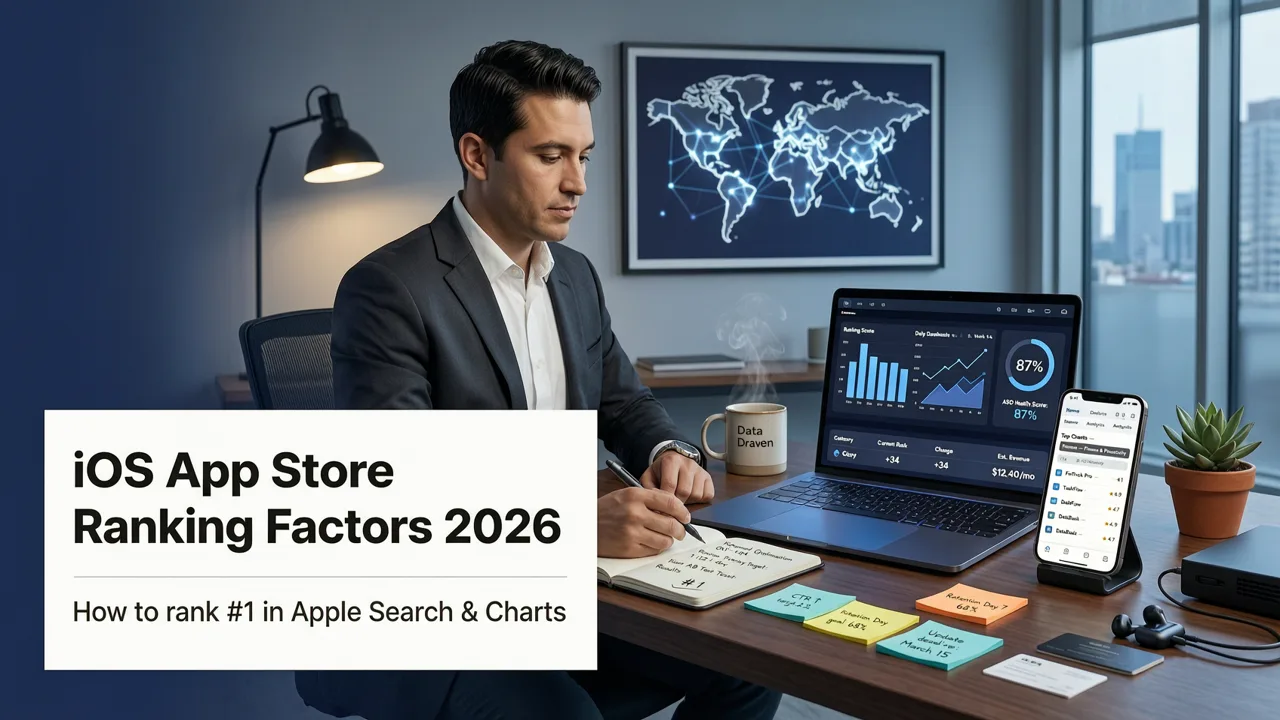
Quick answer: the most influential iOS app store ranking factors in 2026 are keyword relevance in your app name, subtitle and hidden keyword field; download volume and recent download velocity; product page conversion rate; ratings and review signals; post-install engagement and retention; and localization coverage across storefronts. Apple does not publish its formula, but these are the levers publishers can genuinely influence.
This guide breaks down each signal, shows exactly which metadata fields Apple indexes, and gives you a repeatable workflow for moving rankings without gambling on tactics that put your listing at risk.
App Store Optimization: The Proven ASO Framework for 2026
by App Masters
What Are iOS App Store Ranking Factors?
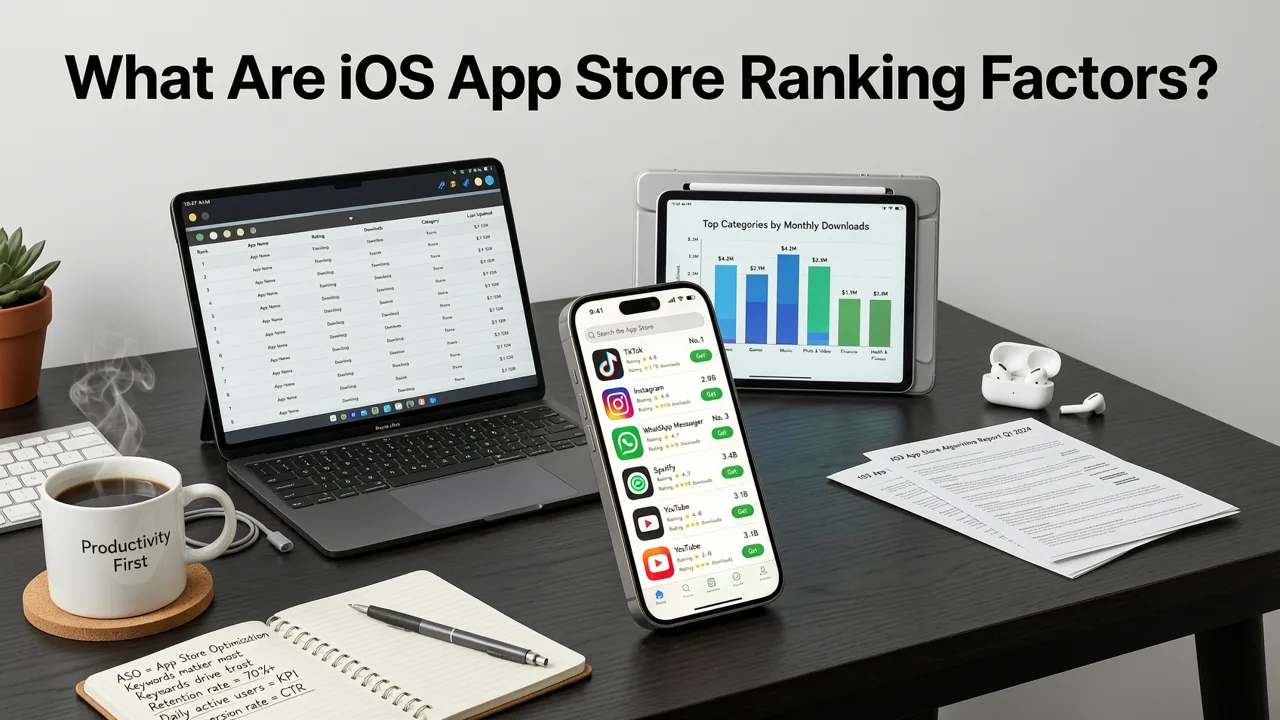
iOS app store ranking factors are the signals Apple's App Store algorithm evaluates to decide where your app appears across three distinct discovery surfaces: keyword search results, category top charts, and browse or editorial placements. Each surface weighs signals differently, which is why an app can rank well for a niche search term while sitting far down its category chart.
Apple treats its exact weighting as proprietary. What is publicly documented is the metadata structure, character limits, and the policies that govern acceptable behaviour. Everything else has been mapped by the ASO community through years of observed correlation between listing changes and ranking movement.
Two practical implications follow. First, relevance is a gate: if your metadata does not establish a clear connection to a query, no amount of download volume will make you rank for it. Second, results are contextual. Storefront, device type, language settings and prior user behaviour all shape what an individual searcher sees, so a single tracked position is a sample, not a universal truth.
The iOS App Store Ranking Factors That Matter Most in 2026
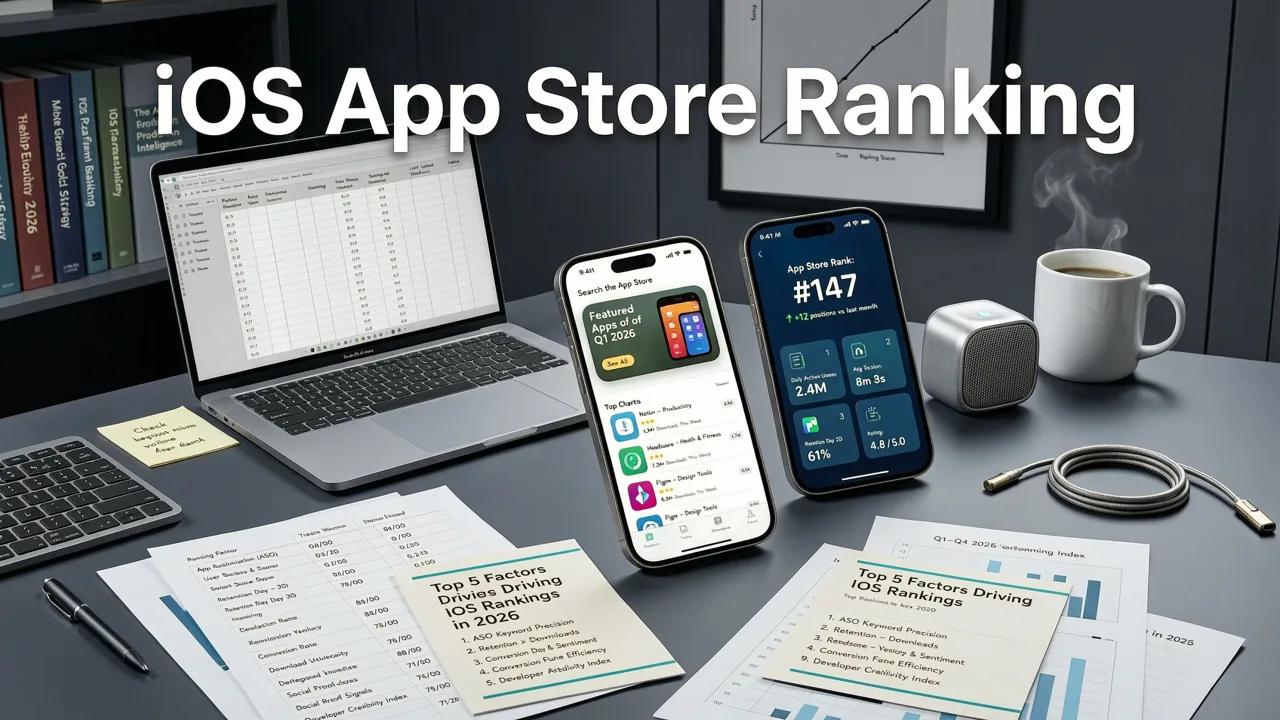
The signals below are ordered roughly by how directly an ASO team can act on them, starting with the ones you fully control.
1. Keyword Relevance in Indexed Metadata
Relevance is the foundation. Apple matches queries against specific fields: the app name, the subtitle, the 100-character keyword field, in-app purchase display names, and certain other structured elements. The long description is not indexed for search on iOS, which remains the single biggest misunderstanding among teams migrating from Google Play.
Placement matters as well as presence. Terms in the app name generally carry more weight than terms in the subtitle, which in turn outweigh the hidden keyword field. Apple also forms combinations across fields, so you rarely need to repeat a word to rank for a phrase containing it.
2. Download Volume and Velocity
Once relevance is established, performance decides the order. Total installs contribute, but recent install momentum matters more, especially installs attributed to a specific search term. An app that converts and installs consistently for a query tends to climb for that query.
Velocity is also why launch spikes, press coverage, and paid campaigns can create temporary ranking lifts. The lift decays if the underlying conversion and retention do not hold, which is why sustainable ASO focuses on steady organic growth rather than one-off bursts.
3. Product Page Conversion Rate
Conversion rate is the bridge between visibility and ranking. Apple can observe how often an impression turns into a product page view, and how often a page view turns into an install. Weak conversion tells the algorithm your listing is a poor match for the query, and rankings soften accordingly.
The assets that drive this are your icon, first two or three screenshots, preview video, average rating, and the opening lines of your description. Custom product pages and product page optimization tests let you match creative to intent instead of guessing.
4. Ratings and Review Signals
Average rating, rating volume, recency, and sentiment all feed into both ranking and conversion. A high score built from a handful of old ratings is weaker than a slightly lower score sustained by a steady flow of recent reviews.
Practical approach: trigger the native review prompt after a moment of genuine value, respond to negative reviews to fix recurring complaints, and never incentivize or purchase reviews. Manipulation violates App Review policy and can jeopardize the listing itself.
5. Retention, Engagement and App Quality
Apple has strong incentives to promote apps people keep using. Signals such as continued usage after install, session frequency, uninstall behaviour, crash rate and launch performance are widely understood to influence how confidently the algorithm promotes an app.
You cannot optimize these through metadata. They improve through onboarding that reaches first value quickly, honest screenshots that set accurate expectations, and disciplined release quality. Mismatched creative can win an install and lose the retention signal that follows.
6. Localization and Storefront Coverage
Localization is a ranking factor, not just a translation task. Each storefront has its own competitive set, search vocabulary and indexing behaviour, and some storefronts draw keyword coverage from more than one localization.
That means a genuinely localized keyword set can expand your reachable query pool without touching your primary language listing. The mechanics of choosing markets and building locale-specific term lists are covered in this ASO localization keyword research guide for 2026.
7. Freshness, Updates and Compliance
Regular, meaningful updates signal an actively maintained product. Update cadence also creates natural opportunities to refresh metadata, seasonal creative and in-app events.
Compliance sits alongside freshness. Current SDK requirements, accurate privacy disclosures, working subscription information and adherence to review guidelines keep your listing eligible for promotion. An app stuck in a rejected or restricted state cannot benefit from any other optimization work.
| Ranking factor | Signal type | Your level of control | How quickly it can move |
|---|---|---|---|
| Keyword relevance in metadata | Textual match | Full | Fast, after review and reindexing |
| Localization coverage | Textual match plus market fit | Full | Fast to medium |
| Conversion rate | Behavioural | High | Medium |
| Ratings and reviews | Quality and sentiment | Medium | Medium to slow |
| Download volume and velocity | Performance | Medium | Medium |
| Retention and app quality | Product experience | Indirect | Slow |
| Editorial featuring | Curated | Low | Unpredictable |
Where Keywords Actually Count: iOS Metadata Field Map
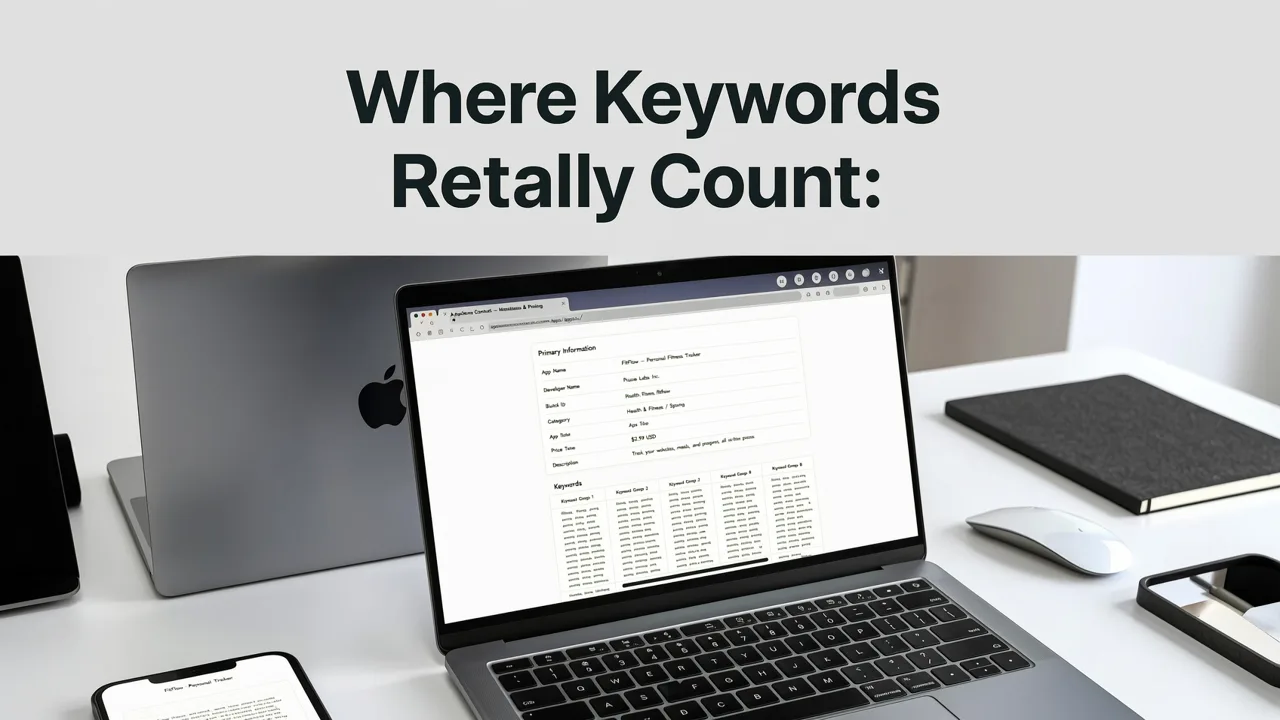
Most wasted ASO effort comes from writing keywords into fields Apple never reads for search. Use this map before your next metadata update.
| Field | Limit | Indexed for iOS search? | Primary job |
|---|---|---|---|
| App name | 30 characters | Yes | Brand plus highest-value term |
| Subtitle | 30 characters | Yes | Secondary terms and value proposition |
| Keyword field | 100 characters | Yes (hidden) | Long-tail and supporting terms |
| In-app purchase names | 30 characters each | Yes | Additional relevant terms |
| Primary category | Selection | Category context | Chart placement and relevance context |
| Long description | 4,000 characters | No | Conversion and clarity |
| Promotional text | 170 characters | No | Timely messaging without a new build |
| Screenshots and video | Asset-based | No | Conversion rate |
A few rules keep this efficient. Separate keyword field terms with commas and no spaces, since spaces consume characters. Skip plurals when the singular is already present. Do not repeat terms across fields. Avoid competitor trademarks and generic filler such as "app" or "free" that add no relevance.
Choosing which terms deserve the scarce space in your app name is a research problem, not a copywriting problem. Build the candidate list first with a structured ASO keyword research strategy, then apply the placement rules in this app store keyword optimization playbook.
How iOS Ranking Signals Differ From Google Play
Cross-platform teams often reuse one metadata set and wonder why Android improves while iOS stalls. The differences are structural.
- Description indexing: Google Play reads the long description for keyword relevance; iOS does not.
- Hidden keyword field: iOS offers a dedicated 100-character field; Google Play has no equivalent.
- Title length: iOS allows 30 characters for the app name plus a 30-character subtitle; Google Play gives a longer single title.
- Creative testing: both platforms support experimentation, but the tooling, asset formats and rollout mechanics differ.
- Behavioural emphasis: Google Play leans heavily on engagement and uninstall signals; iOS balances relevance, conversion and install momentum with quality signals.
Treat each store as its own optimization project with shared research and separate execution.
Search Rankings, Top Charts and Editorial Featuring Are Not the Same
Keyword search rankings
Query-specific and relevance-gated. You compete only against apps Apple considers relevant to that term, which is why long-tail phrases with clear intent are often the fastest wins for a new or small app.
Category top charts
Driven primarily by recent install momentum within a category, with quality and velocity weighting. Charts reward scale and spikes, so they are usually a lagging indicator of broader growth rather than an ASO target in themselves.
Editorial featuring and in-app events
Curated surfaces influenced by design quality, platform feature adoption, accessibility, timely content and clear storytelling. In-app events add a live, searchable card that can surface your app for seasonal or update-driven interest. Featuring is worth pursuing, but it should never be the backbone of a growth plan.
A Practical Workflow for Improving iOS Rankings
- Audit your current state. Record baseline keyword positions, impressions, product page views, conversion rate, rating profile and category rank per storefront before changing anything.
- Build a relevance map. Group candidate terms by intent, estimated popularity and difficulty. Separate brand, competitor, category and problem-led queries.
- Allocate metadata deliberately. Put your strongest defensible term in the app name, complementary terms in the subtitle, and long-tail variations in the keyword field with no duplication.
- Fix conversion before chasing volume. Rewrite the first screenshot captions around outcomes, lead with your differentiator, and make the icon legible at small sizes.
- Localize where the opportunity is real. Prioritize storefronts with meaningful demand and weaker competition, then research terms natively rather than translating your English list.
- Ship, measure, iterate. Change one variable group at a time, allow reindexing and a stable measurement window, then compare against your baseline.
- Reinforce with product work. Improve onboarding, request reviews at value moments, and reduce crashes so the behavioural signals support your metadata gains.
Myths and Tactics That Can Hurt You
- "Write keywords into the description." No search benefit on iOS. Use that space to convert.
- "Repeat the keyword everywhere." Duplication wastes characters and can look spammy without adding relevance.
- "Paid ads directly buy organic rank." Apple Search Ads do not grant an organic ranking boost. They can generate installs and valuable query-level data, and any resulting momentum is an indirect effect.
- "Buy installs or reviews to climb faster." Incentivized installs and review manipulation violate App Review policy and risk removal, not just ranking loss.
- "Stuff competitor brand names." Trademark misuse invites rejection and legal exposure.
- "One update is enough." Competitors change metadata, seasonal demand shifts, and conversion creative fatigues. ASO is a cycle, not a project.
Tracking Whether Your ASO Work Is Actually Working
Rankings alone are a vanity metric. Judge performance against a small set of connected indicators, reviewed per storefront and per keyword cluster.
- Keyword visibility: how many target terms you rank for, and how many sit in the top ten.
- Impressions and product page views: whether visibility is actually reaching users.
- Conversion rate: the clearest read on creative and message-market fit.
- Organic installs: the outcome that matters, separated from paid and referral sources.
- Rating trend: recent average and volume, not lifetime average.
- Retention: whether the installs you win are the right ones.
Keep a simple change log with dates. When a ranking moves, you want to know whether it followed a metadata update, a creative test, a competitor launch or a seasonal shift. Without that log, teams end up crediting the wrong action and repeating it.
Final Thoughts: Turn Ranking Factors Into a Repeatable System
The iOS app store ranking factors are not a secret checklist. They are a system: relevance earns you entry, conversion earns you momentum, and product quality keeps you there. Publishers who win in 2026 treat metadata, creative and retention as one connected loop rather than three unrelated tasks.
Start with the highest-leverage step you can complete this week: audit which of your indexed characters are wasted, then rebuild that space around researched, high-intent terms. If you want an experienced partner for keyword research, ASO audits, competitor analysis and metadata optimization across iOS and Android, ASOFlo works with developers, startups and app marketing teams on exactly that. Map your baseline, fix your relevance gaps, and let compounding organic growth do the rest.